LUMINNOVATE

Underwriting and credit memos.

A credit officer can trust a memo drafted with AI only if every figure in it can be traced back. Luminnovate reads the application, the bank account, the registers and the bureau, and writes a memo where each number links to the evidence it came from.

SME files rarely say what the business actually earns. Bank inflows mix customer payments with loan proceeds, owner money and transfers, and declared figures go untested against the account.

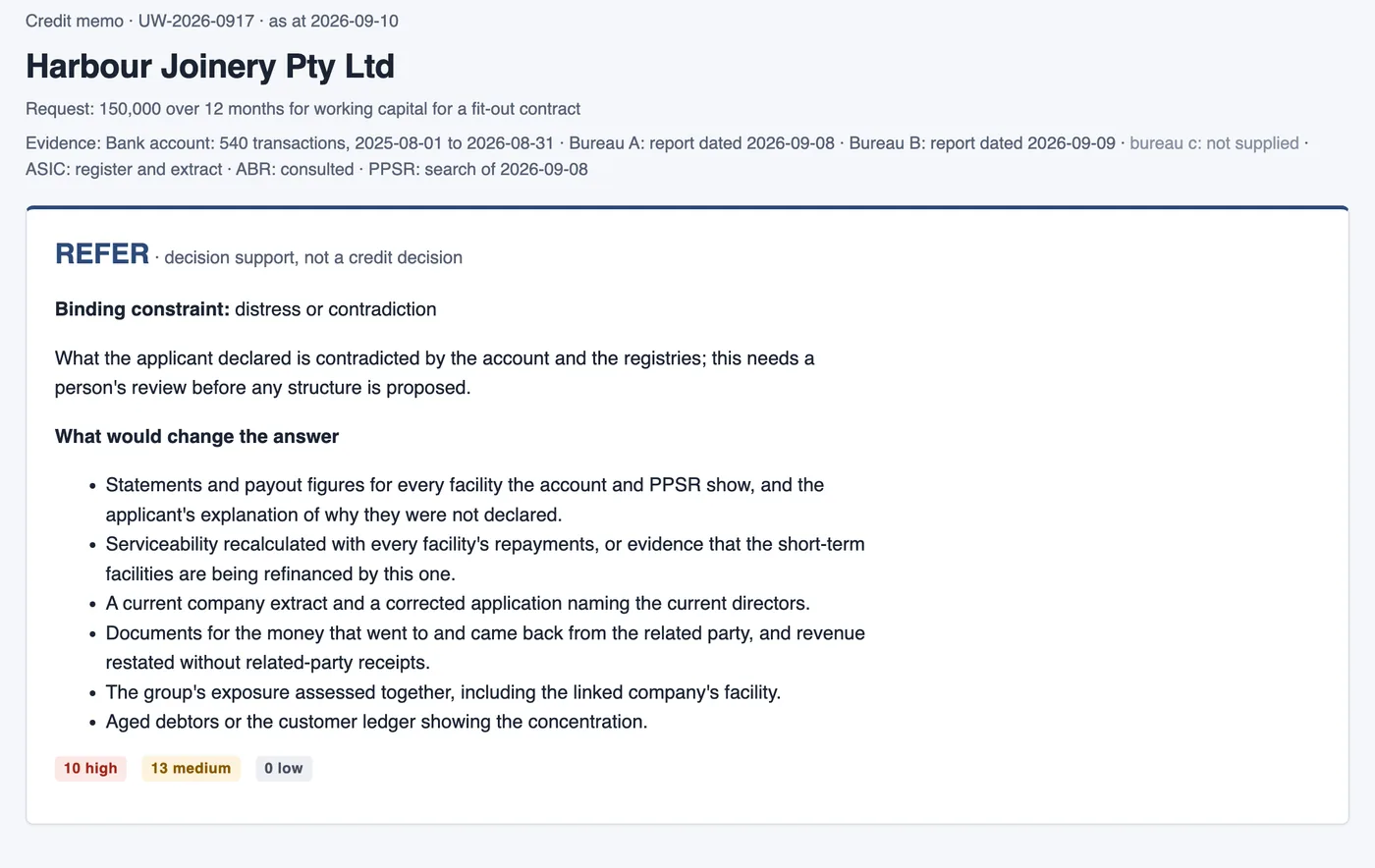
The first page of a credit memo for Harbour Joinery: the recommendation Refer, the binding constraint, and the evidence that would change the answer.
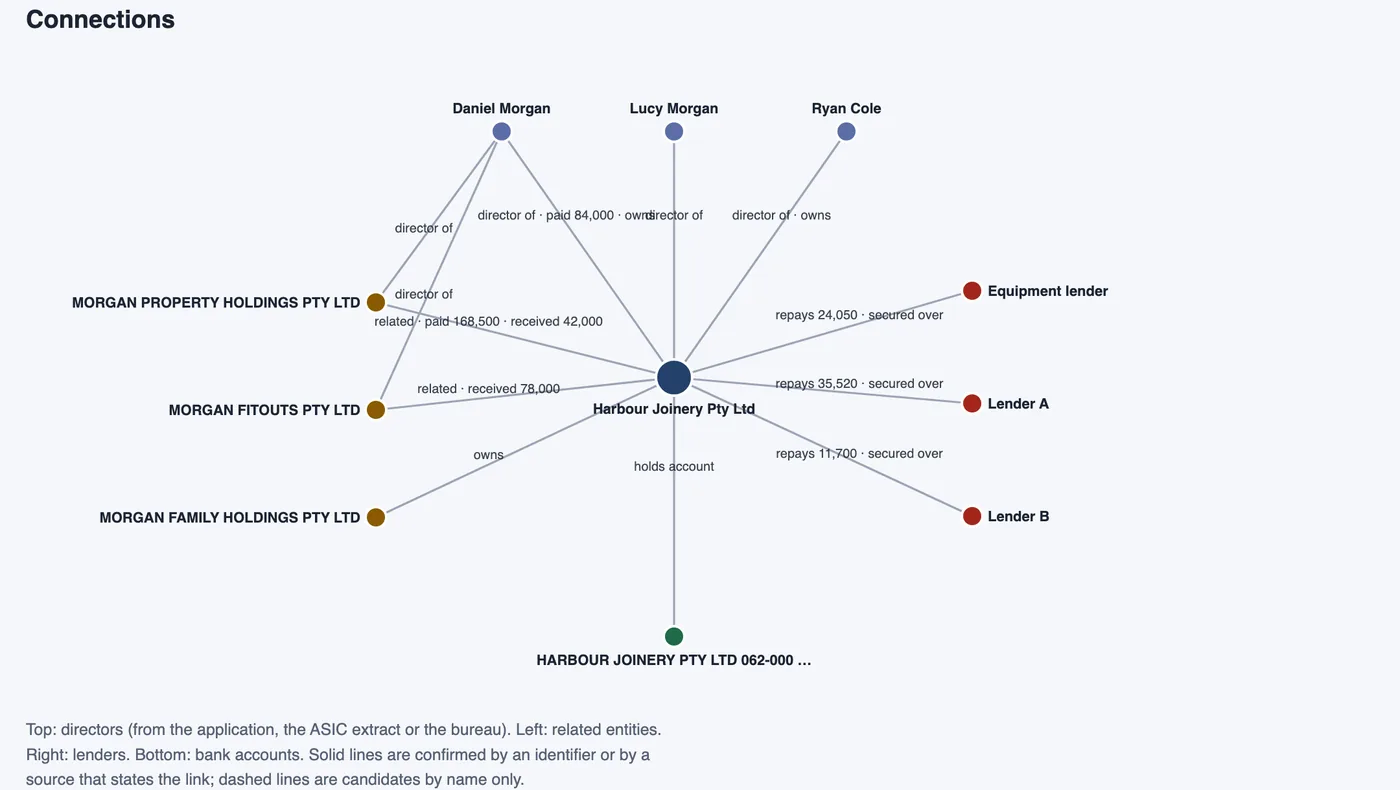
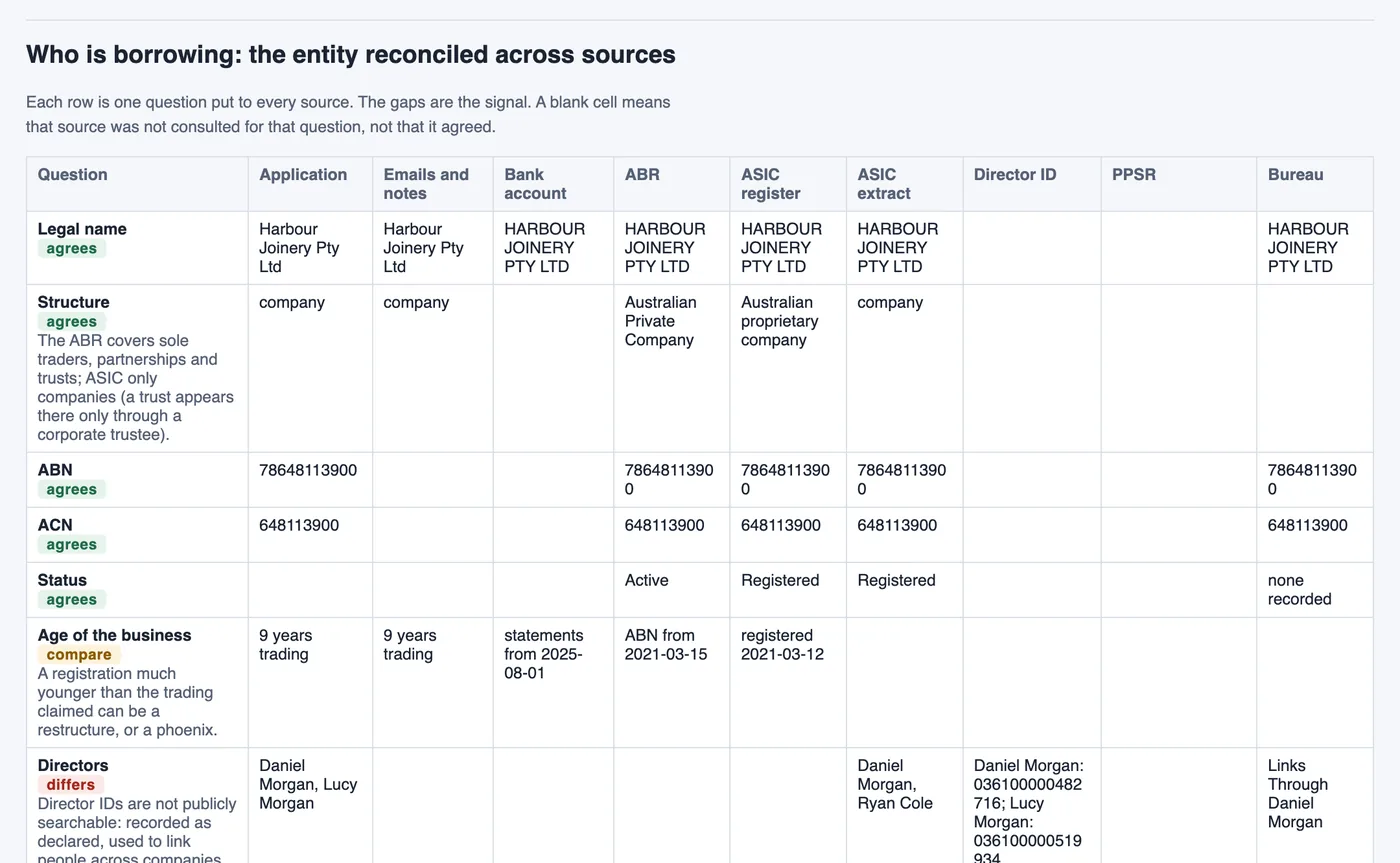
Illustrative example. Harbour Joinery is a synthetic business; lender and bureau names are placeholders.
A network linking Harbour Joinery to its directors, related companies, lenders and bank account.
Who is connected to whom, and the money between them.
The same questions put to the application, bank account, ABR, ASIC, director IDs, PPSR and bureau side by side.
Who is borrowing, asked of every source.

Four stages, one memo

  • ReadThe application, the bank account and the broker's note, each flow read for what it does.
  • CheckEvery claim tested against the account, the registers and the bureau.
  • ConnectThe people, companies and lenders behind the applicant, and the money between them.
  • DecideA memo that shows its working, with the evidence that would change the answer. A person approves.

Two cases

These are results from Luminnovate's work, labelled by source. Unlike the illustrations above, the figures are not invented for this page.

$778,800Illustrative worked example

Revenue overstated by inflows

counted as revenue by a categoriser; $528,800 of it was customers paying

What was observed
$778,800 came into the business account over six months.
What a generic approach says
A categoriser counts all of it as revenue.
What the engine read
True revenue was $528,800. The rest was $180,000 of loan proceeds, a $45,000 owner injection and $25,000 moving between the business's own accounts.
What it meant for the decision
Net surplus was $174,200, not $516,820: repayment capacity was overstated roughly three times.
$231,704Synthetic business

The builder whose loan masked a fall

fall in revenue hidden inside a small dip in money in

What was observed
Total money in fell only $62,176.
What a generic approach says
A small dip in an otherwise steady business.
What the engine read
A $169,528 loan settlement masked a $231,704 fall in revenue. Three customers who paid $200,493 from January to June 2025 stopped paying, and the main customer fell from $270,908 to $156,108. A new daily facility of $1,520.76 was found from its pattern alone: 59 payments since May 2026.
What it meant for the decision
Eight grounded questions for the credit officer, each tied to the evidence behind it.

Start with files you have already funded. We read them the way these cases were read, inside your environment, and you compare the result with what your own process concluded.

Book a conversation